
I’ve had a rather Shakespearean run over the last few weeks.
Bard-heavy, you might say?
I say, that with productions of Romeo and Juliet and Falstaff in Manchester (and a quick return visit to Shakespeare country, Stratford-upon-Avon itself), it’s been a joy to immerse myself in texts which are classically brilliant in their origins but then given such individual and fresh new takes in their retelling.
And this production was no different.
Tensions in London’s East End are rising and Shylock, a resilient single mother and hard-working businesswoman, is desperate to protect her daughter’s future.
When the charismatic merchant Antonio comes to her for a loan, a high-stakes deal is struck.
Will Shylock take revenge, and who will pay the ultimate price?
Starring Tracy-Ann Oberman in the role of Shylock, this highly-charged, powerful adaptation of The Merchant of Venice returned to co-producer HOME, Manchester, last week, following its highly successful visit earlier in the year.

Set in the 1930s against rising political unrest, we’re taken through the traditional narrative of one man, Antonio, who, in order to help his friend, Bassanio, ‘win’ the chance to court the beautiful Portia, requires a loan.
Money is money, business is business, and, whilst there is little love lost between the anti-semitic Antonio and Jewish money-lender Shylock, a deal is struck. The forfeit on defaulting on the loan? The infamous ‘pound of flesh’.

Anti-semitic tensions are displayed not only in the narrative and dialogue of this classic tale but, in the costumes, the increasingly daubed set of Shylock’s residence, and in the powerful projected imagery of headlines from the period as Hitler and Nazi-Germany stepped up its campaign and the persecution of Jews became increasingly widespread.

For those not familiar with the text, it may sound trite and inappropriate to remind that there is a comedic nature to this play and, indeed, this still comes through. Perhaps one of the finest performances of drunken vulgarity I’ve ever seen, was from Xavier Starr. And it raised a smile when it should, quickly replaced by sadness when it should – as, all with intent, the comedic turned to offence.

As each of the superb cast took their turn in the spotlight, the acting and delivery was as on professional point as you would hope and expect.
And breaking through the fourth wall, for a moment, there was opportunity for some audience members to witness this masterclass in close proximity, as they took their onstage side seats. I applaud their courage in taking up this offer. This audience member would have been far too preoccupied panicking that I’d fall off my chair, get cramp or ponder way too much as to what expression I should adopt throughout, lest I laugh and put on a gummy display.
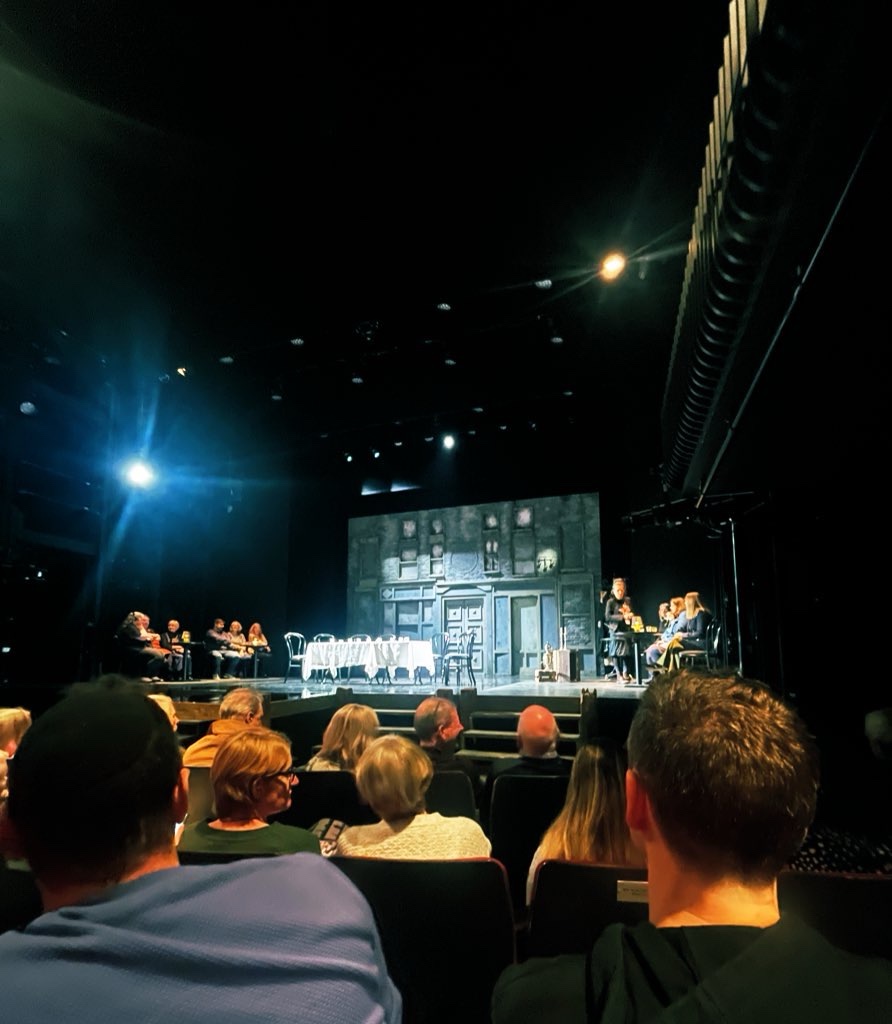
Indeed there was much to enjoy in the court scene as Portia (Hannah Morrish) and her ‘servant’ and companion Nerissa (Jessica Dennis) undertook their disguises and transformation into men of the court, jostling with and chiding their unsuspecting husbands, as they admiringly multi-tasked in attempting to reverse Antonio’s fatal penalty for defaulting on the loan, whilst also managing to test their in attendance spouses on previous promises to never remove their wedding rings..!
Never underestimate us women (I jest – also I don’t…)
But once again collective mirth turned to moving silence as Tracy-Ann Oberman, commanded the stage in Shylock’s utter despondence upon realising (spoiler) she had been defeated, and revenge hadn’t been realised.
Indeed, Raymond Couthard’s Antonio was as dastardly, as metaphorically moustache-twirling and as eyebrow-raisingly abhorrent as you would want. As again, with everything in this production, this review is positively oxymoronic as I uncomfortably pronounce the unpleasant, anti-Semitic character as having an air of panache and charisma.

Similarly, there is an age-old argument over whether Shylock is the victim or villain of the piece. For Shylock is the abused, yet she is also the unrelenting, without compassion and unrepentant in her insistence that she collect in kind, the aforementioned pound of flesh.

As in life there are victims and villains and roles somewhere in between. But without leaning too far into explicit political commentary on the events of the 30s and 40s, there are some situations in history where this line is far, far less blurred.
As the play concluded, the fascist iconography increasing in presence in every scene, the text continued in its relocation to London, and we were (seamlessly, it felt) taken straight into The Battle of Cable Street – the 1936, ‘a clash between the Met police, (sent into protect members of the British Union of Fascists on their march led by Oswald Mosley), and anti-fascist members of society, local trade unions and many British Jews.
This climatic and powerful closing scene, previewed throughout by the aforementioned projected headlines and black and white footage, saw all cast throwing off their characters’ individual proclivities, as all players came together as one on the side of anti-fascism.
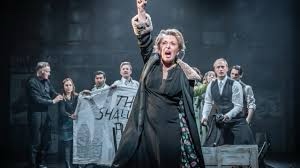
And as the audience were encouraged to stand and join in rousing battle cries of being stronger together, The Merchant of Venice 1936 was yet another reminder of how Shakespeare’s classic texts and themes are as relevant today (and indeed, 80-odd years ago) as they ever were and will continue to be.
To read more about the cast, crew and production, please visit:
https://homemcr.org/production/the-merchant-of-venice-1936/
Ahead if it’s next stop in Stratford-upon-Avon in January 2024, you can read more at the production’s official website:
 honorary manc
Leave a comment