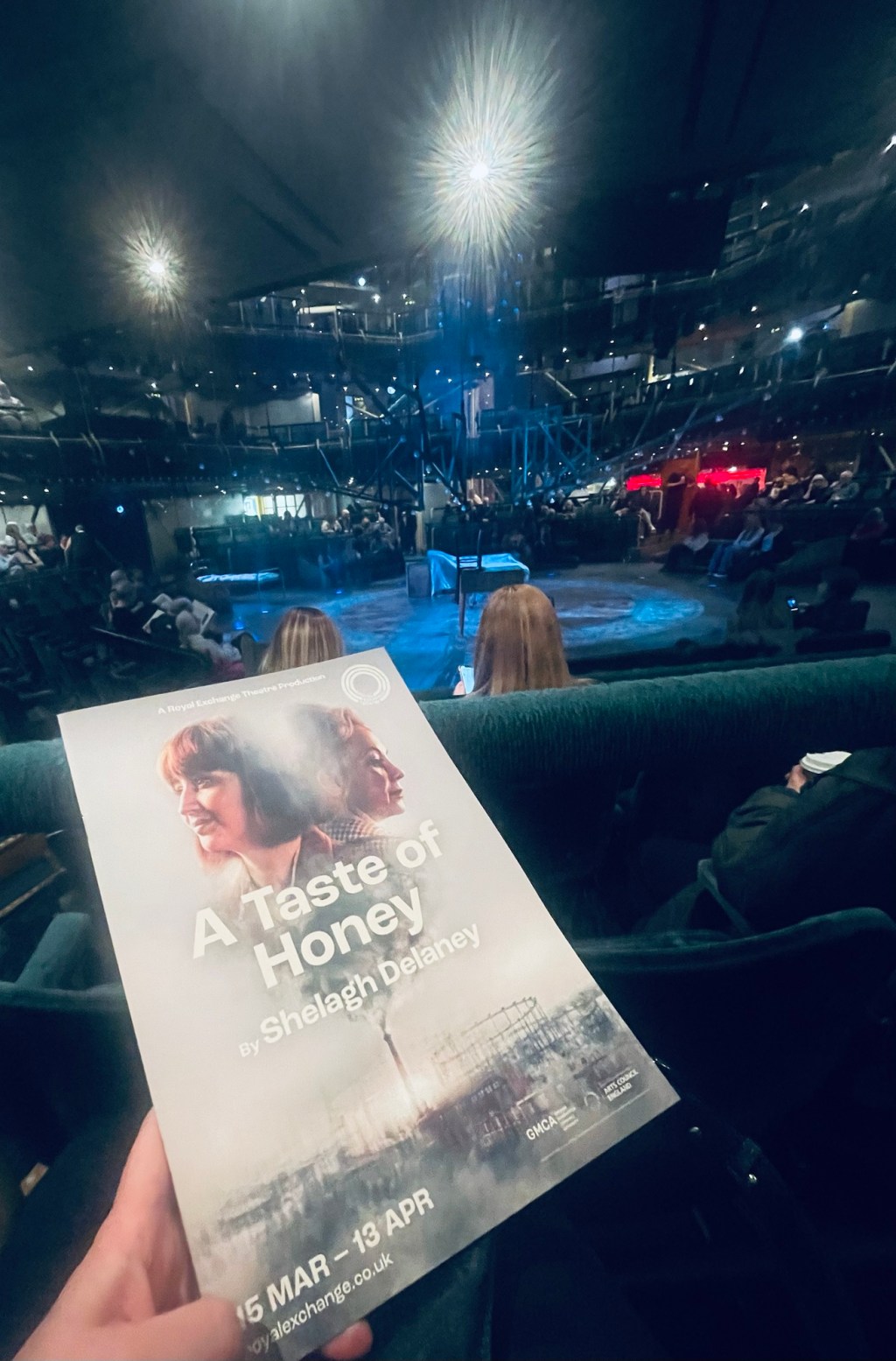
I’m sat writing this looking out on Salford Docks. Well strictly speaking Salford Quays. Well strictly speaking, one of the Basins, with all its accoutrements; bridge(s), birds, runners, dog-walkers, lanyard bedecked workers, high-rises… But not the high-rises that one would have come to expect from Salford. A whole different shinier, floor-to-ceiling windowier animal.
And yet when this play was written, the original tower blocks of Salford and such, would still be a twinkle in the eye of architecture.
A stunning portrayal of the complex bond between a mother and daughter who, despite their sharp bickering, are both holding on for that Taste of Honey.
Helen has done it again, another fly-by-night flit dragging Jo from one Salford flat to another, only this time she has out done herself giving her daughter panoramic views of the slaughterhouse.
But Jo can feel her Mum’s restlessness, another man will appear and lure her away and Jo will be left to fend for herself, so when Jimmie offers to stay for Christmas Jo is swept up in his charm and the promise of escape – no matter how precarious that may be.
A Taste of Honey, and all of its parts, is an iconic piece of popular culture, both in its original play form and film adaptation which was to come later.
It was written in the late 1950s by teenage Salfordian, Shelagh Delaney. As many of the kitchen sink dramas which were to emanate from the period (Look Back in Anger, Saturday Night, Sunday Morning), it was a stark contrast and antidote to the classical theatre world.
And what draws me into such texts is the dialogue. The very beautiful, rich, witty, blunt yet, at times, paradoxically fantastical dialogue.
As Delaney herself once said,
I write how people talk
And, well, shared credit to those people.
This production, directed by Emma Baggott, and starring Rowan Robinson as Jo, Jill Halfpenny as Helen, is thankfully, for myself, faithful to providing a platform and a spotlight on the truly delicious dialogue that flows without pause, that makes A Taste of Honey what it is.
Some might say – well what is a play if not the words written down and spoken. True, that. But, whilst there is much room (and indeed appreciation, certainly from this author), for theatrical text to give way to a more abstract way of telling a story, with symbolism at the heart of its design in the sets, the lighting, the music, the costume, the props…this play has dialogue at its core and required no other distraction.

And so on that wonderfully iconic stage, ‘in the round’, it’s not unusual for productions at the Royal Exchange to lean heavily into sparsity of traditional props, furniture and back drops. But often this is complimented or perhaps substituted by the aforementioned use of other mediums to tease the senses.
Not so here. We had a bed, we had a sofa, a couple of tables and chairs and a little kitchenette off to the side, to accommodate much brew-making and little else. At least until Geoffrey turned up (but more on that later – he brought a plant too…).
And so, we had the era-appropriate costumes, furniture and dialogue and were ready to (rock and) roll.

From the opening scenes where Helen and Jo drop anchor, so to speak, in their latest Salford bedsit, the actors owned the words and indeed the characters and delivered them both to each other, and, with the occasional aside from Helen, to the audience, as through those words were written fresh by Delaney, just yesterday.
And whilst the 1950s play tackles racism, homophobia and poverty and confronts them at varying degrees of subtlety in the play, time leads us to shift uncomfortably at certain terms, and we remind ourselves of context and worthy intent when first written. And whilst semantics will always lead to jarring as time and society evolves, themes remain the same at heart and we can all identify with the topics which Delany was unafraid to bring to the fore all those years ago.
Halfpenny’s (I hate writing just surnames – maybe I shouldn’t and should go with my instincts but I’ll think on that…) performance as the flighty, fearsome Helen was as good as any role I’ve seen her in. As with all elements of the production, the portrayal was owned, and her back and forths with daughter Jo, were a joy to behold. Each fight felt like it was too close to call, mother daughter evenly matched until one would take the knock-out punch -either Helen with the aid of age and experience, or Jo with youthful exuberance, a younger than her years cynicism or good old cutting blow.
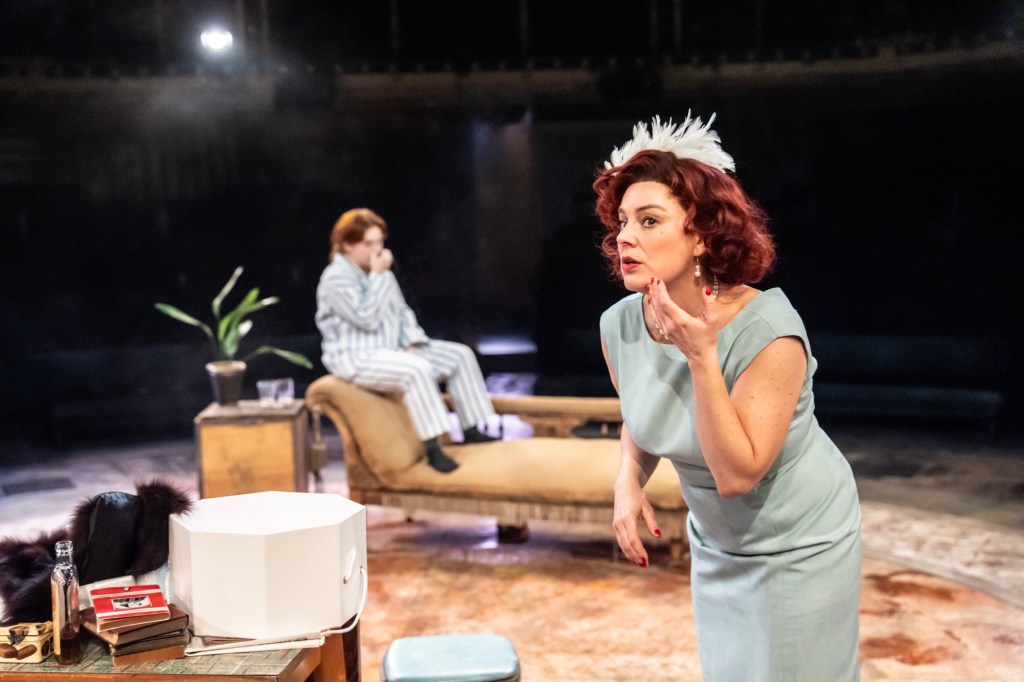
Robinson’s Jo was one that left you feeling that Delaney had written it with the actress in mind. Whilst Robinson is indeed from Salford, an important yet coincidental detail, I’m pretty sure raw talent has a lot to do with it.
Either way, the authenticity and kinship to the role and heart of the production itself, Salford, is strong.
Whilst the women take literal centre-stage in the story, we of course had Helen’s younger, one-eyed beau, Peter (Andrew Sheridan) And as the slimy salesman-type snaked his way back into Helen’s life and bed, I was torn between feeling sorry for her and deciding that she got everything she deserved. Pretty sure Sheridan’s portrayal was precisely what Delaney had in mind (I really need to find a different name referencing approach…).
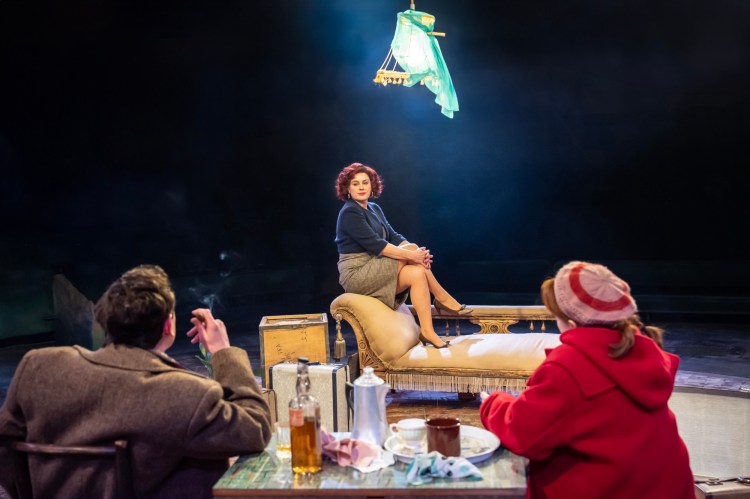
Whilst his appearances felt somewhat brief in the story (you don’t say, I hear the character of Jo wryly interject), Obadiah as Jimmie, Jo’s beau and I guess you would call (spoiler) ‘baby-daddy’ in today’s modern parlance, did enough in the role to make me believe his intentions were true and was coming back from sea, never mind his fiancee Jo.
And Geoffrey (David Moorst). Geoffrey, Geoffrey, Geoffrey. Only this character and performance could have distracted me from the absence of Helen on stage. Taking his place as Jo’s sparring partner, their play and interactions where funny, tender and whilst brutal at times, sensitive with their mutual (and platonic) love for each other shining through with every statement and retort.

And whilst homophobia is by no means a distant memory, we see a character and portrayal of a man who is haunted, closeted and so vulnerable, is willing to pledge his life to that of being married to Jo. And whilst one of comfort, support, even love, it would be a marriage which would be of convenience, no matter how he tried to kid himself that he could conform to society’s (at the time) expectations.
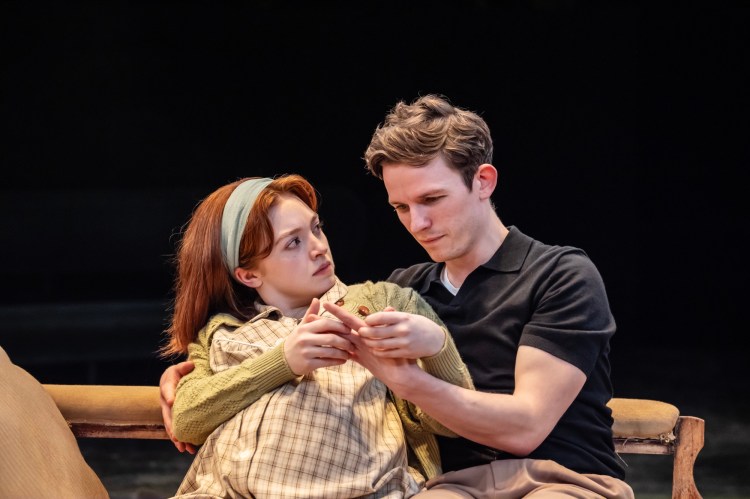
As with all aspects of the play, there is occasionally light where there is dark, and relief for both Jo and Geoffrey when the kindred spirits give way to their very real lives and pressures, and embrace their artistic natures as they entertain each other with song, dance and tongue in cheek dramatic readings of nursery rhymes and tales.
Indeed song itself plays an important role in this production, as a device to introduce, and bookmark each scene and bring to a close our tale. Device is of course too clinical a term to describe the beautiful voice of (credited as) the jazz singer, Nishia Smith, an ethereal figure on the edge of proceedings, singing, amongst others, a beautiful interpretation of the Salford anthem, Dirty Old Town.

And so, whilst my blog has blurred boundaries between discussing the origin text, the origin themes and inspiration that is Salford and, indeed, this production of A Taste of Honey at the Royal Exchange Theatre, on reflection I think that can only be the biggest compliment I can pay as a theatre-goer in my appreciation of the work.
Shelagh Delany is Salford is a Taste of Honey is now this production.
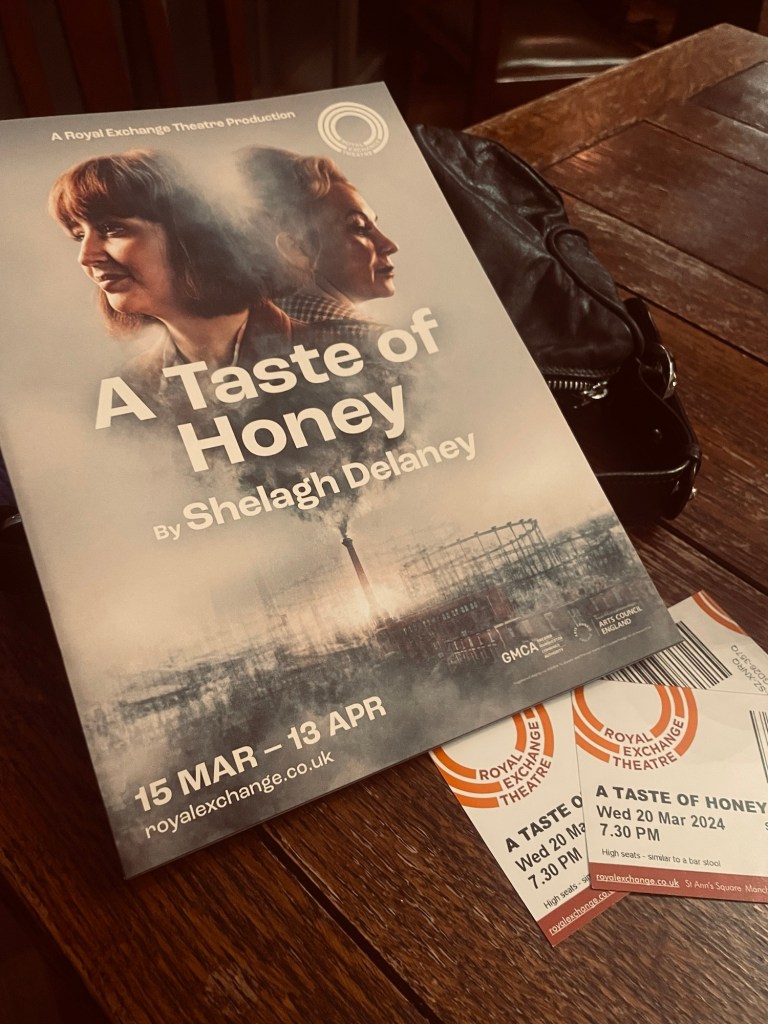
You can see A Taste of Honey, a Royal Exchange Theatre production, until Sat 13 April. Click here for details and tickets.
Directed – Emma Baggott, Designer: Peter Butler , Lighting Designer – Simisola Majekodunmi, Sound Designer:- George Dennis, Fight and Intimacy Director – Kaitlin Howard , Arranger/Orchestrator: – Alexandra Faye Braithwaite , Movement Director – Sarita Piotrowski, The Royal Exchange Theatre, 2024,

 honorary manc
Leave a comment