
I think if we were asked to write a list of our triggers, well apart from the very act being very triggering, I bet we wouldn’t automatically be able to put a comprehensive list together. The thing with triggers, is that we don’t always know what our personal ones are. Until they pop up and boom there it is.
I’ve noticed over the years an increase in trigger warnings. All welcome and received. And a helpful device in communicating to the audience not only a warning but an acknowledgement that certain actions, themes, language, behaviours come from a knowing and artistic place with an intention for them to be received within a certain context and with a purpose.
Fringe theatre is a place of boundary-pushing but with that comes a responsibility. And Salford Arts Theatre did their due diligence when I attended on Sunday.

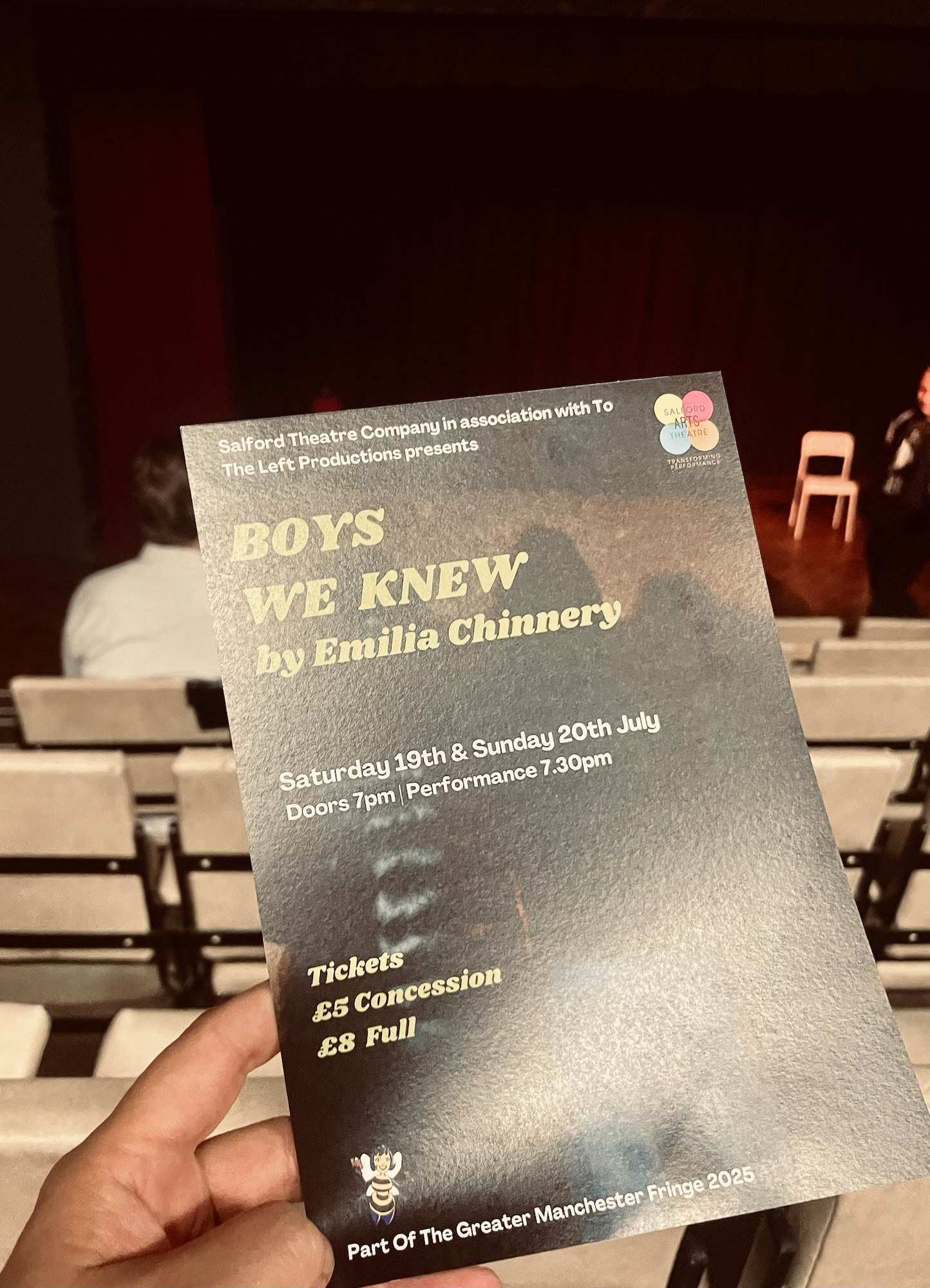
Boys We Knew follows three best friends, Liam, CJ and Jasper, who spend their time between their B-Tech music college and house parties.
The boys originally seem to maintain a toxic dynamic in their misogynistic attitudes and dispassion for progress.There is a breaking in the group dynamic as Liam attempts to free himself from a future consumed by drugs and repressive behaviour, finding hope in a friendship with a bright girl named Angelica.
However, Liam finds difficulty in distancing from the cultural norms of the white, working class.
Initially I had trouble placing where Boys We Knew sat on the timeline. The boys I saw were the boys I knew from my 90s school days.
Checklist:
- floppy hair
- baggy jeans (it’s gotta be a Loose Fit)
- Oasis
- Stone Roses
- The Prodigy
- Happy Mondays
- Busy patterned sofas (the horror)
Oh, but wait, hang on.
I noted the Breaking Bad poster. Nope. Red wine at house parties – heaven forbid. Mobile phones – we should have coco’d.
So actually maybe these were boys the generation after me knew. Or the generation after that. Why get hung up on years. We in the audience were witnessing boys we all knew. Different boys, maybe different brands of offensive opinions, different vernacular to express those offensive opinions (that’s where the trigger warnings came in handy, the extent at which required according to tolerance – for example – I’m good with the strongest, most sweary-ey of swearwords to comedic affect, less so with homophobic slurs, ableist language and the diminishing of women – so fortunately I was in the brace position, ready to receive and contextualise accordingly).
We had misogyny straight out of the Andrew Tate handbook, a theme that’s been with us since the beginning of time, with ebbs and flows, changing influences, and post-modern versions of – a theme steeped in history but these days with a deeply unpleasant but modern ‘twist’ for the youth.

The ignorance, some born out of naivety, some out of wilful rebellion, is a thread which I’m sure we can all attest to from our younger selves. And as with language, fashion, music rebellion and popular culture, themes and behaviours are cyclical and, to that end, it didn’t matter what time and space the performances were set within. The characters were definitely, in my case, boys we knew (well some of them), and to varying degrees know now.
The origin reasons for the trigger warnings in the first place, were what made these performances and characters so well-rounded and three-dimensional.
As we bore witness to peer pressure, acts of rebellion, soul-searching and teenagers navigating their way through the intense period of discovery and identity that is those years, there were reactionary moments of discomfort, empathy, sympathy, laughter and disgust. It’s a risk when any piece of art can bring out strong and contradictory emotions, but for me there was never any danger in misunderstanding why words and sentiments were expressed. These characters were never in danger of not being viewed as flawed when was the intention.
Fringe theatre. The beauty of it exists in its bravery. One minute it is providing a stage for fanciful flights of imagination and surreal expeditions into the minds of some off the scale funny and biting performers of our time, and the next playing host to a bravery that displays itself in being unafraid to hold a stark mirror up to reality and the ugly sides of society.
Boys We Knew was a look through a lens at a few months in time (it didn’t matter when) where tales were left untold, issues left unresolved, redemption arcs left incomplete…and it was everything you’d want it to be. No tying things up in a pretty bow here.
In addition to the insightful and acutely observed writing of Emilia Chinnery in her first full-length play, and thoughtful direction of Roni Ellis, the performances of the actors on stage brought meaning and authenticity to the words.

The cast Gabriel Keogh (Jasper), James Grundy (Liam), Oliver Davenport (CJ) and Shauna Jackman (Angelica) were their characters (for I’m sure only 60 minutes – no casting aspersions here), and it was testament to everyone that I wanted a revisit to their lives every seven years to check out their evolutions and learning curves – those that we’re all on.
I left Salford Arts Theatre with an appetite and hope to see more of all concerned their work in future productions. And I don’t think you can say fairer than that.
Boys We Knew was produced By Salford Arts Theatre in association with To The Left Productions, with the support of the Shelagh Delaney New Writing Award, and part of this year’s GM Fringe Festival.
To find out what else is coming up at the festival, visit Events – Greater Manchester Fringe
To read more about Salford Arts Theatre, visit https://www.salfordartstheatre.com/.

 honorary manc
Leave a comment